James Thinks
writing is a kind of thinking
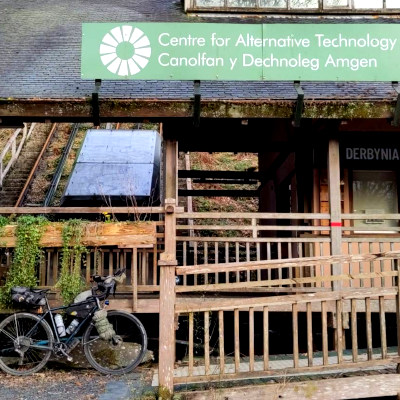
I recently attended the Centre for Alternative Technology course: Zero Carbon Britain - Scaling-up Community Action in the Climate and Ecological Emergency. I took in some inspiring and informative content, networked with other attendees and experienced the green geeky delights of the centre itself as I stayed over for two nights.

What is CAT?
The Centre for Alternative Technology, also known as CAT is like a mini-university experimenting with and demonstrating sustainable building materials and energy sources. It is found in the Welsh hills near Machynlleth on the site of an old slate quarry. This is a remote location, but only a three-mile walk from the nearest railway or a very hilly bike ride from Bristol!
Power is delivered via solar, wind and hyrdo power. The site is connected to the grid, but probably exports more than it imports.
Buildings are made from rammed earth or straw bales. The most impressive is the Sheppard lecture theatre in the WISE building.


Some of the techniques used on site are experimental, and various bits have been half-abandoned, often to see how long they will last or whether they can be studied or reused later. As a result, CAT doesn't feel like a tidy theme park. That said, the accomodation was very comfortable. Spacious en-suite rooms, just no mini-bar or flat-screen TV.
For me, seeing all this beautifully-simple technology in action was a great benefit of attending. These days CAT does not accept day visitors, but does offer a wide range of short courses and events you can book. The course I attended will be repeated online soon. The easiest way to visit is on one of their in-person or virtual open days.
How was the course?

The course I attended involved a number of 30-60 minute lectures and discussions led by CAT's staff with support from visiting speakers with experience scaling up climate action in local communities. The content was interesting to me and everyone seemed to enjoy it. There was a lot to take in and despite taking notes, I found it difficult to build a coherent plan for my own community. The content and discussions did prompt me to consider new possibilities, but overall the course was more inspiring than practical. Perhaps this would have been easier if I had been able to attend with a small delegation from my town! However, I was reminded of the benefit of repair cafes as a concept and having heard about their popularity in some climate-oblivious parts of the country, I will see whether this can be encouraged locally.
The quote which stuck with me most was during Rob Hopkins' talk: "Any useful statement about the future should, at first, seem ridiculous.". To me this is a call to reject pragmatism and be ambitious. We were also reminded that building a vision of the future is a necessary, though not sufficient, condition for achieving it. We should be working out what we want our community to look like, then work backwards to understand how we could get there. Not to do so will trap us into tiny, incremental changes that cannot keep pace with the need for climate adaptation.

What else did you experience?
For me, half of the benefit of doing this course was the opportunity to get to know the other attendees. There were about 25 of us, some professionals, some volunteers, working in communities across the country. It's always good to spend time around like-minded people and hear their challenges and ambitions. Several signed up to give short talks on what they were doing in their communities, be they towns, national parks, medical practices or an inner-city community. I wanted to give a talk of my own, but realised that everyone there knew more about most aspects of that than I did. At the last minute I wrote my name on the list to speak about "Rewilding Social Media", a title I made up on the spot. Possibly a bit of a buzzword bandwangon jump, but it felt right. I spoke about how most social media is owned by super-rich "tech bros" - people who not generally supportive of social change and whose algorithms promote conflict rather than community. The alternative is community-owned social media such as the Fediverse and in particular Mastodon. This has the additional benefit that servers can be owned and run by anyone and, should you need to move servers, you can take your address and connections with you. I was unsure how relevant this would be to participants, but several people thanked me for it afterwards and could appreciate the benefits of federated media for community building.
Highlights from the tour of the CAT site





James Bradbury
I write about whatever is on my mind. I do so mostly to help me think more clearly. If other people find it interesting that's good too. :-)
CAT is like a mini-university with sustainable building materials and energy sources.
It doesn't feel like a tidy theme park.
"Any useful statement about the future should, at first, seem ridiculous."